
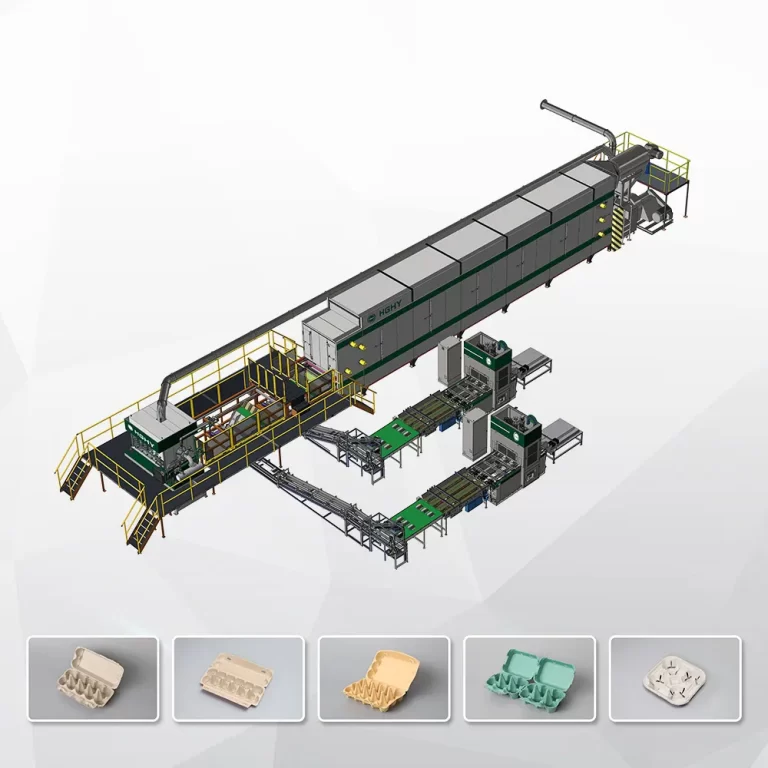
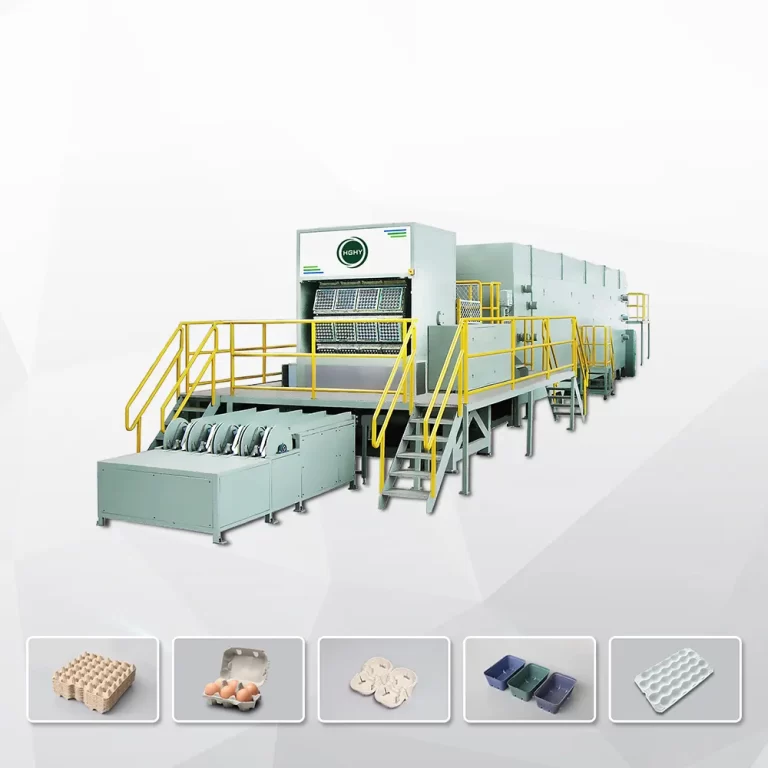

Among the different ways to shape wet pulp into finished trays, the rotary drum forming line is the one built for volume. Where a flat-bed machine forms a single batch and stops to transfer it, a rotary line keeps turning — forming, transferring, and releasing product in a continuous cycle. That difference is exactly why high-output tray plants are built around this configuration rather than a reciprocating one.
For anyone weighing a pulp molding investment focused on egg trays and similar standard-shape packaging, understanding what a rotary drum line does, what it can make, and what it produces per hour is the starting point.
What a rotary drum pulp forming line actually is
The core of the line is a large rotating drum fitted with forming molds around its circumference. As the drum turns through a pulp vat, vacuum draws the fibre slurry onto the mould faces and forms the wet product. The drum then rotates that formed piece to a transfer position, where it is picked off and passed to the drying line — while the next mould face is already dipping into the pulp behind it.
That rotation is the whole point. Because forming and transfer happen on different faces of the same turning drum, the machine never has to stop and reset between pieces. HGHY builds this as a double rotary configuration — six forming faces working alongside six transfer faces — which is what allows the line to run 50 to 60 drops every minute without interruption.
What products it can make
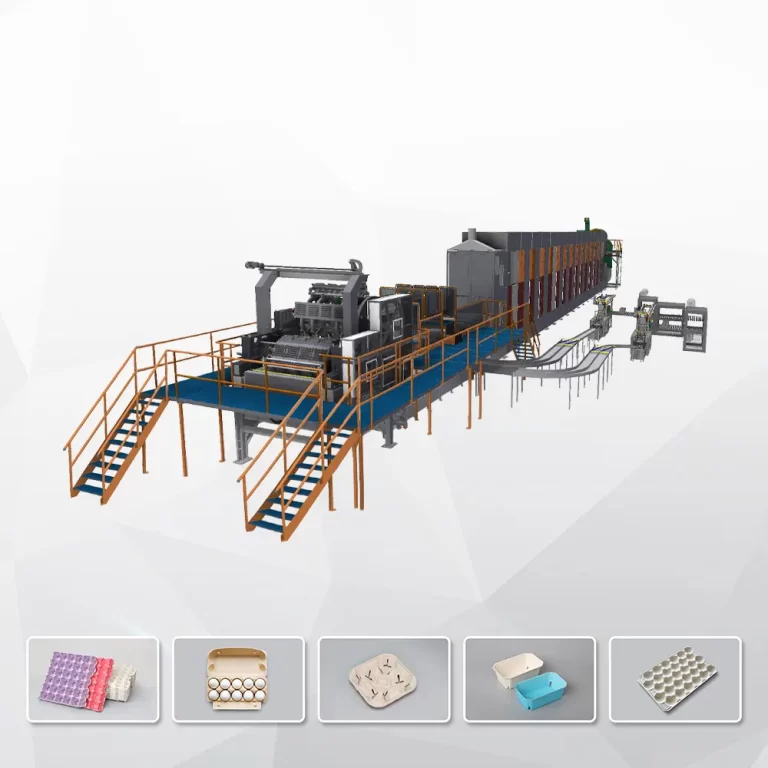
The rotary drum line is designed for regular-shape, standard products made in high volume. Egg trays are the classic case, but the same machine handles a much wider range simply by changing the moulds.
- Egg trays in the common formats — 30-egg, 24-egg, and 20-egg trays.
- Fruit trays for apples, pears and similar produce, where the moulded pockets cushion each item.
- Cup carrier trays and coffee cup trays for takeaway and beverage service.
- Bottle trays for separating and protecting bottled goods in transit.
- Electronic product packaging and other protective inserts.
- Shoe trays and further custom shapes drawn from alternative mould sets.
The rule of thumb is straightforward: if a product is a regular, repeatable shape needed in large quantity, this line makes it. For deep-drawn, high-finish tableware or intricate premium packaging, a hot-press or thermoforming line is the better fit — the rotary drum’s strength is throughput on standard trays.
How the line works, stage by stage
A rotary drum line is more than the forming machine alone. It is a full production chain that turns waste paper into stacked, wrapped trays.
Pulp preparation
Waste paper — old newspaper and recycled stock — is broken down with water into a slurry. The pulp then passes through impurity separation, screening, cleaning and de-flaking to remove contaminants, followed by proportioning so the fibre consistency feeding the forming machine stays stable. Bagasse, bamboo or wood pulp can be used as the fibre source depending on what is available.
Forming
The prepared slurry is pulled onto the rotating mould faces by vacuum suction. Each formed piece is then handed off by a transfer mould and sent onward to the dryer. With six forming faces and six transfer faces working in rotation, this stage sets the pace for the entire line.
Drying
The wet trays travel through a multi-layer drying oven, where hot air is applied evenly across the product surface to drive off moisture. HGHY’s rotary line uses a 10-layer dryer, and the heat source is flexible — diesel, natural gas, LPG or LNG, or a boiler system running steam or conduction oil. Since drying is the biggest energy cost in pulp molding, matching the fuel to what is cheapest locally has a direct effect on running cost.
Stacking and packaging
Once dry, the trays are conveyed, counted and stacked automatically, then compressed and shrink-wrapped for storage or shipping. Automating this end of the line is what keeps labour down to a handful of operators per shift despite the high output.
Capacity and technical specifications
Capacity scales with the platen size of the forming drum. HGHY offers the rotary drum line in three standard models, all sharing the same high-speed double rotary forming principle and differing mainly in width and output.
| Parameter | 2000~6000B2C | 9000B2C | 12000B2C |
|---|---|---|---|
| Molding technology | Rotary | High-speed double rotary | High-speed double rotary |
| Molding faces | 4/8 forming + 1transfer | 6 forming + 6 transfer | 6 forming + 6 transfer |
| Platen size | 1600 × 400 mm | 1250 × 460 mm | 1650 × 460 mm |
| Drops per minute | 10–20 | 50–60 | 50–60 |
| Capacity / hour | 2000~6000 pcs | 9,000 pcs | 12,000 pcs |
| Raw material | Waste paper | Waste paper | Waste paper |
The headline figure is throughput: from 2,000 up to 12,000 pieces per hour, which works out to roughly 168,000 to 288,000 trays a day in continuous operation. Notably, that jump from the smallest to the largest model nearly doubles output while the crew size barely changes — a big part of why the economics improve with capacity on this type of line.
Choosing the right configuration
A few practical points separate a good purchase from an oversized one.
Match the model to real demand rather than peak ambition. A plant that genuinely needs 7,000 trays an hour should not buy the 12,000 line and run it half-loaded — the smaller model will carry a lower footprint and energy bill. Floor space matters too: the largest model needs a 90 × 24 metre plan, so the building has to be planned around it. And because the dryer accepts several fuel types, the choice of heat source should follow local energy prices, since it drives the single largest operating cost.
Manufacturer experience and support
Equipment at this scale is a multi-year commitment, so the supplier’s track record carries weight. HGHY has helped more than 300 clients in over 60 countries set up pulp molding plants, and holds CE and ISO9001 certification along with more than 160 patents.
For project planning, a few reference points are useful:
- Production and shipping: roughly 130 days from confirmed order, deposit and/or L/C.
- Installation: two guide installers are dispatched to lead the build, with commissioning typically taking 60–90 days depending on how much equipment is purchased.
- Return on investment: based on completed projects, payback usually falls within two to three years.
In summary
The rotary drum pulp forming line earns its place wherever standard trays are needed in serious quantity. Its continuous double-rotary action delivers 7,000 to 12,000 pieces per hour, it runs on cheap waste paper, and it flexes from egg trays to fruit trays, cup carriers, bottle trays and protective inserts with a change of mould. For a high-volume tray operation, it is the configuration that turns recycled paper into a dependable, saleable product at scale.
 English
 Spanish
 French
 Thai