

Uzbekistan’s poultry sector has been expanding faster than the packaging that serves it. Egg output across the country keeps climbing, driven by a growing population, rising domestic consumption and government support for agricultural self-sufficiency. Yet a large share of the paper egg trays that protect those eggs on their way to market is still brought in from outside the country. That gap — strong local egg production, weak local tray supply — is exactly where a molded pulp egg tray production line becomes a business worth examining closely.
A market that already exists
Most packaging investments require educating a market first. This one does not. Every egg farm, wholesaler and retailer in Uzbekistan already uses trays; the only question is where those trays come from. Currently much of the supply is imported, which means longer lead times, currency exposure, freight cost on a bulky low-density product, and margin handed to producers in neighbouring countries.
A domestic line turns that equation around. Trays are made where the eggs are, sold in local currency, and delivered in days rather than weeks. For a buyer used to importing, a reliable local supplier is not a hard sell — it is a relief.
Raw material that costs almost nothing
The economics of egg tray manufacturing rest on one unusual advantage: the raw material is waste paper. Old newspapers, cardboard boxes, printing offcuts and mixed recovered paper are the feedstock, all widely available and cheaply collected across Uzbekistan’s cities.
Waste paper turned into a finished tray that sells at a solid margin is the core of the business case. Because the input is so inexpensive and locally sourced, the line is largely insulated from the import costs and supply shocks that affect plastic or virgin-pulp alternatives. The environmental angle reinforces the economics — the trays are fully recyclable and compostable, aligning with the direction global and regional packaging regulation is already heading.
What a production line actually includes
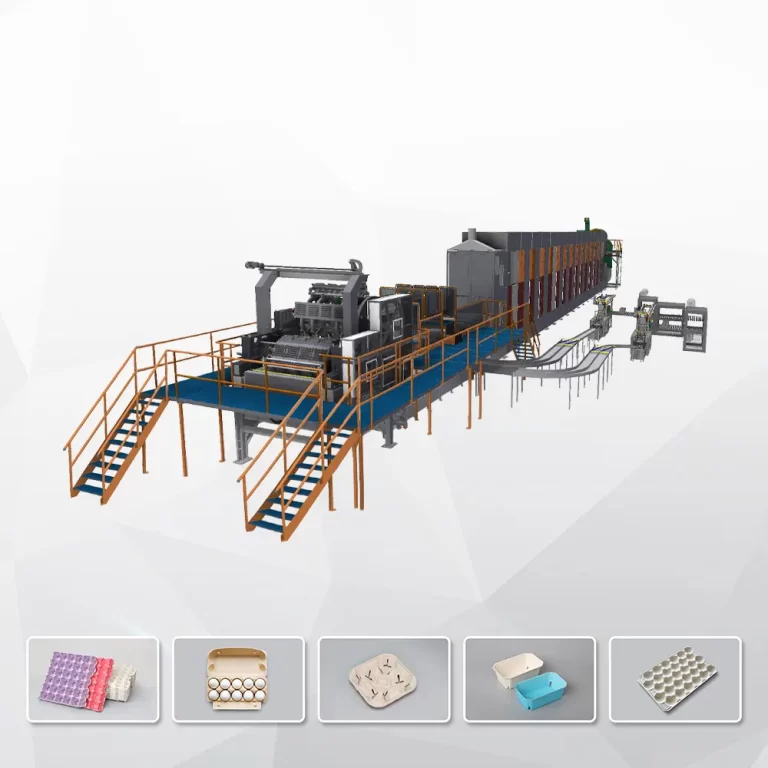
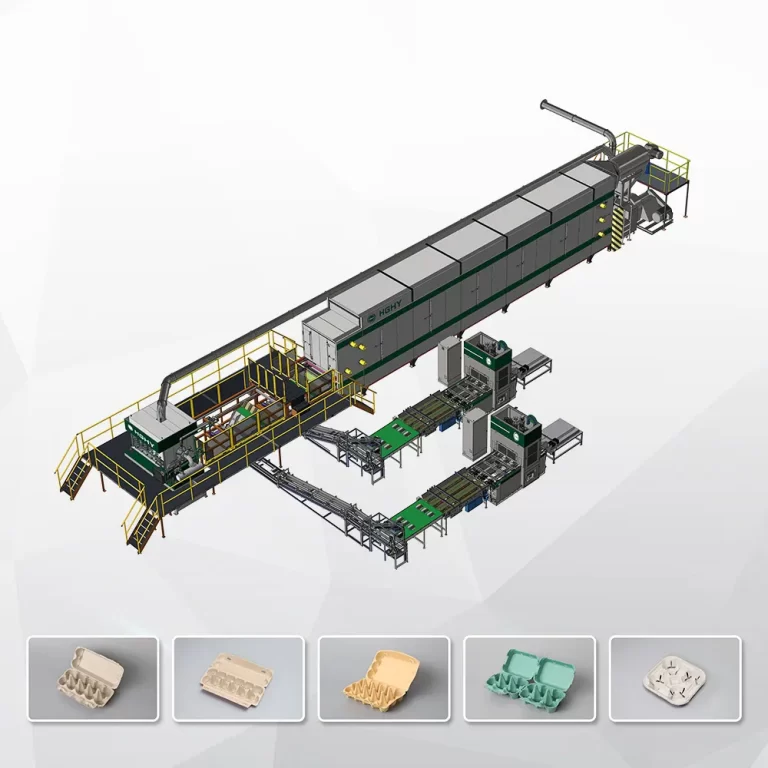
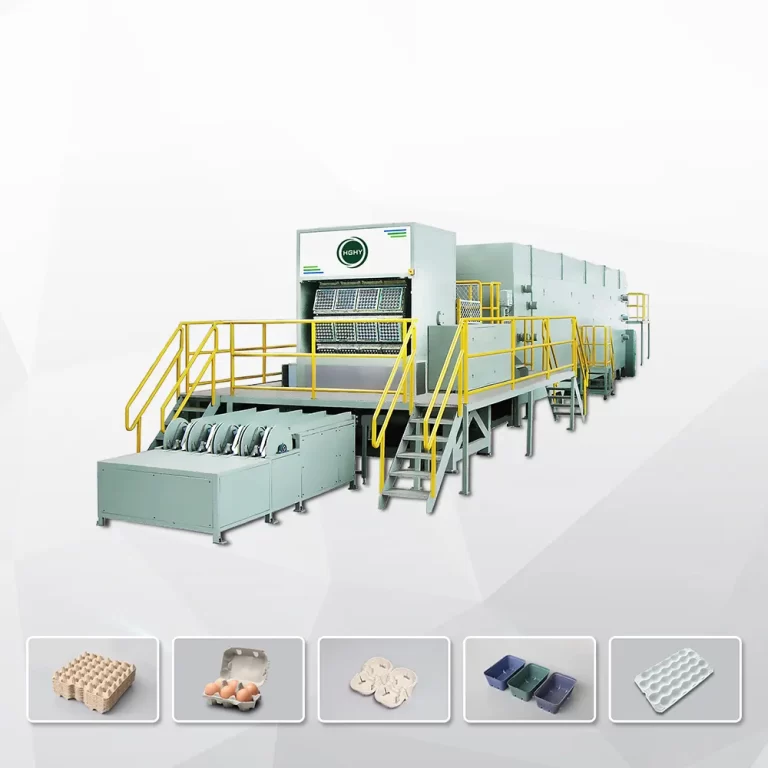
An egg tray line is a connected system rather than a single machine. Understanding the parts helps clarify where cost and capacity come from:
- Pulping — recovered paper is mixed with water and broken down into a fibre slurry, then screened to remove contaminants.
- Forming — the slurry is drawn onto tray-shaped moulds by vacuum, taking the familiar cushioned egg-tray shape.
- Drying — the wet trays pass through a drying system that sets their strength and shape; this stage is the largest energy user and the main driver of running cost.
- Stacking and packing — finished trays are counted, stacked and bundled for shipment, manually on smaller lines or automatically on larger ones.
The drying method is where the biggest configuration choice sits. Natural (air) drying suits low labour-cost startups with space to spare; a metal-frame or brick drying line raises throughput and consistency for higher-volume operations.
Matching capacity to ambition
Egg tray lines scale across a wide range, and the right size depends on target market and available capital. Output is measured in pieces per hour, and configurations commonly run from a few thousand up to several thousand trays hourly, with drying capacity and automation level setting the ceiling.
A smaller line is a sensible entry point for a single region or a farm-attached operation. A higher-capacity, more automated line makes sense for a supplier aiming to serve wholesalers nationally or to export to neighbouring Central Asian markets — where the same import-dependence gap exists and Uzbek-made trays could compete well on freight.
Beyond egg trays
The same molded pulp platform is not limited to egg trays. With a change of moulds, comparable equipment produces fruit trays, cup trays, bottle trays, industrial protective packaging and — on tableware-grade machines — plates, bowls and food containers. For an investor, that flexibility is a hedge: a line bought for egg trays today can follow demand into adjacent packaging categories tomorrow, without replacing the core system.
What to look for in an equipment partner
The machine is only half of the investment; the supplier behind it determines whether the line runs profitably for years. Several points separate a serious partner from a broker:
- Proven installations — a track record of lines running in real factories, not just catalogue specifications.
- Turnkey scope — pulping, forming, drying and packing supplied and integrated as one system, with clear responsibility for making them work together.
- Installation and commissioning — on-site setup, calibration and operator training, so the line reaches rated output rather than sitting half-tuned.
- After-sales support and spare parts — fast access to wear parts and technical help, since downtime on a continuous line is expensive.
- Return on investment clarity — a supplier confident enough to walk through realistic payback based on local paper cost, energy price and tray selling price.
The HGHY line
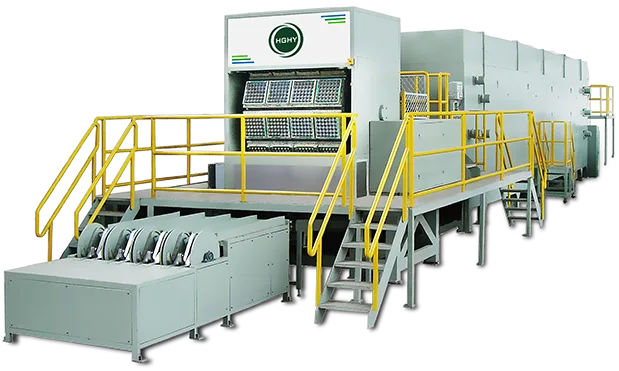
HGHY builds molded pulp equipment for exactly this profile of investment, with egg tray and egg carton lines among its core products. Its systems are supplied as complete lines — from pulping through to drying and packing — and are already running with a broad base of customers across more than sixty countries. For an Uzbek operator, that combination matters: turnkey delivery, commissioning support and a documented installation history reduce the risk of taking on a first packaging line.
Heating and drying can be configured to the energy source that is cheapest locally, and the equipment is designed for continuous operation with straightforward maintenance — two factors that directly protect the margin on a low-cost, high-volume product like egg trays.
A window worth acting on
The case for a domestic egg tray line in Uzbekistan comes down to timing. Egg production is rising, tray supply still leans on imports, raw material is abundant and cheap, and the environmental pressure that will eventually squeeze plastic packaging is only building. An investor who establishes reliable local tray capacity now steps into an existing, growing market with a structural cost advantage that importers cannot match.
For a detailed line configuration, capacity options and a project-specific ROI estimate based on local costs, it is worth requesting a quotation and specification sheet directly through the HGHY website. A short enquiry with target output and location is enough to receive a tailored proposal for an egg tray production line suited to the Uzbek market.
 English
 Spanish
 French
 Thai