
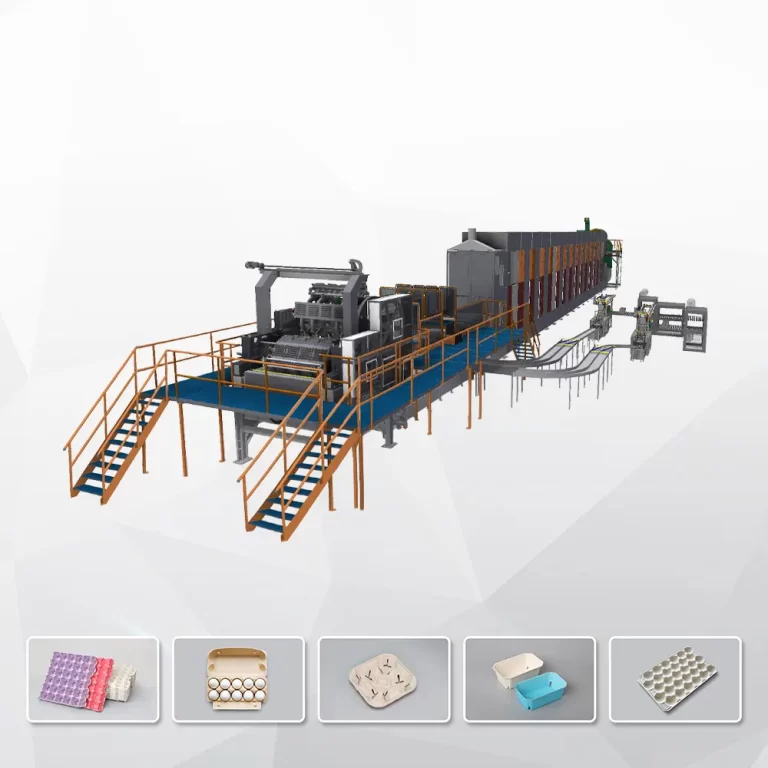
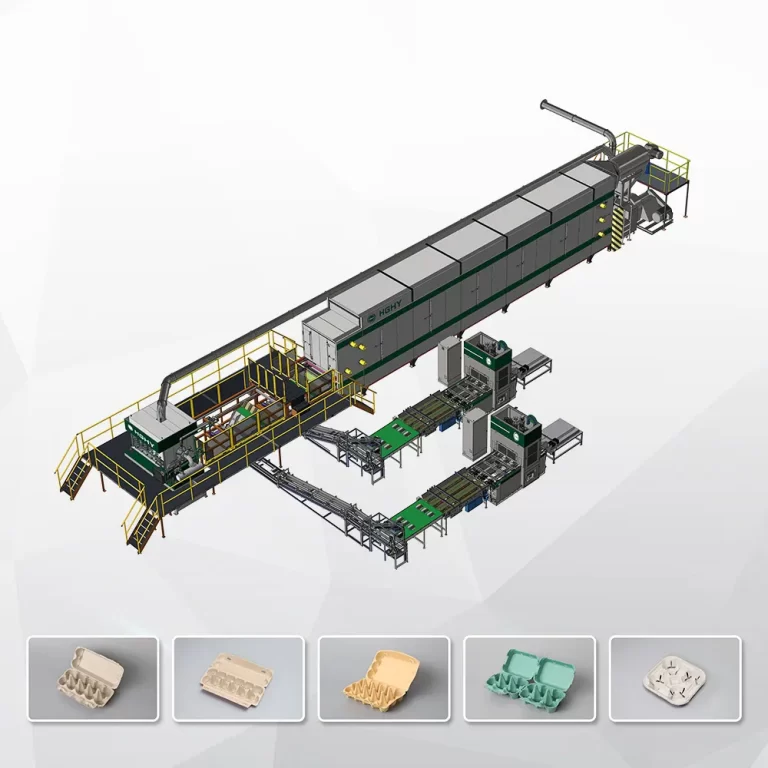
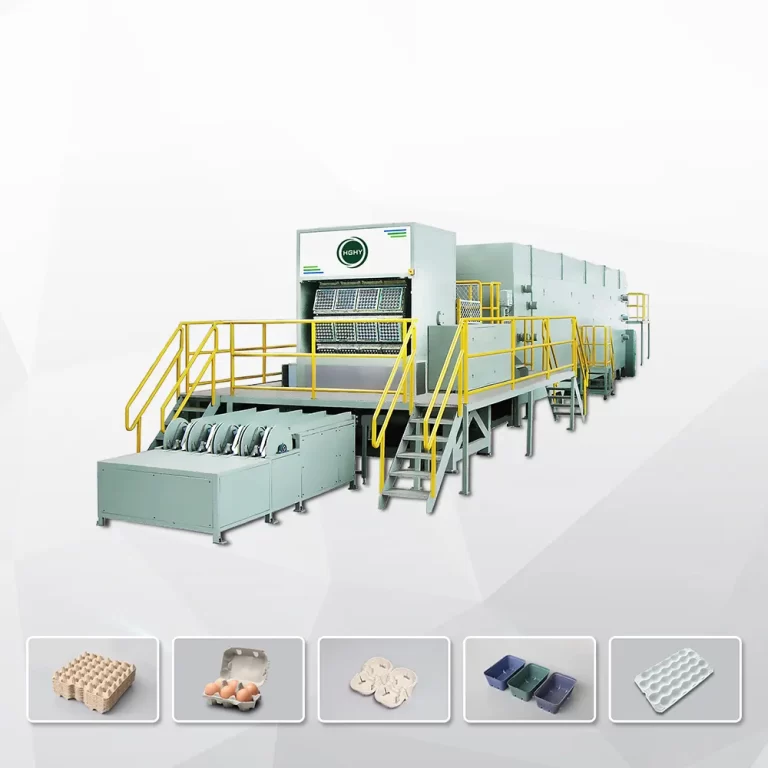

An industrial egg tray drying system can be engineered around several heat sources, commonly including natural gas, diesel, coal, and liquefied petroleum gas (LPG). The right choice depends less on the fuel’s headline price than on local availability, supply reliability, delivery infrastructure, emissions requirements, dryer configuration, operator capability, and the cost of keeping the line running through every shift.
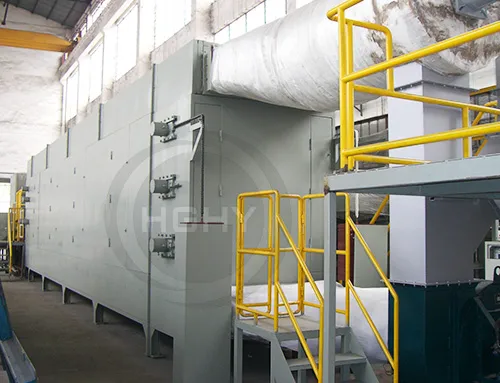
For most projects, the dryer is the main thermal consumer in the egg tray production line. It removes the water remaining after forming so that trays can reach the moisture level, shape stability, and stacking strength required for packing and shipment. A fuel decision therefore affects not only operating cost, but also temperature control, maintenance, plant layout, safety systems, and product consistency.
Why fuel selection matters in egg tray drying
Freshly formed pulp trays contain a large amount of water. The drying system must provide stable heat and airflow long enough to remove that water without overdrying, scorching, warping, or creating inconsistent tray quality.
A practical fuel choice should help the dryer deliver:
- stable and controllable heat input;
- consistent final tray moisture;
- uniform drying across the full dryer width and length;
- reliable operation during planned production hours;
- manageable maintenance and cleaning;
- compliance with local safety and emissions requirements;
- a realistic total cost over the equipment’s operating life.
The best fuel is therefore local and project-specific. A fuel that is inexpensive per unit of energy can still be a poor choice if supply is unreliable, permits are difficult, operators need excessive manual intervention, or the system cannot maintain the required drying profile.
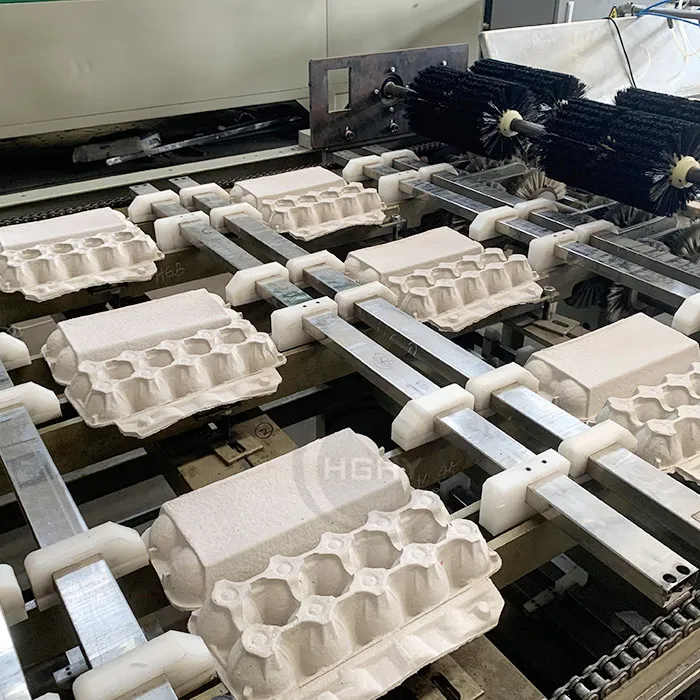
Understand how an egg tray dryer uses heat
In a typical production line, trays move from the forming section into a dryer where heated air removes remaining moisture. The drying system may use a burner, furnace, thermal-oil arrangement, steam source, or other heat-generation equipment to warm the circulating air.
The exact configuration varies by line capacity and dryer design, but the fuel-selection questions remain the same:
- How much heat is needed to meet the required finished-tray output?
- How quickly must the system heat up at the start of a shift?
- How accurately must temperature be controlled for the selected tray design?
- What fuel connection, storage, handling, and safety infrastructure is available on site?
- What maintenance and emissions-control equipment is required?
A supplier should size the complete drying system—not only the burner—around actual production capacity, incoming tray moisture, target final moisture, ambient conditions, dryer heat losses, and expected operating hours.
Compare natural gas, diesel, coal, and LPG
| Fuel option | Typical strengths | Key limitations | Project conditions where it may fit |
|---|---|---|---|
| Natural gas | Clean combustion profile relative to solid fuels; responsive heat control; no on-site solid-fuel handling or ash removal. | Requires dependable pipeline access or a defined gas supply arrangement; connection and permitting can take time. | Plants with stable gas infrastructure, tight control requirements, and a preference for lower on-site handling complexity. |
| Diesel | Can be stored on site; useful where a gas grid is unavailable; burner response can be controlled well. | Requires tank storage, fuel deliveries, spill prevention, and attention to fuel-price volatility and emissions. | Remote sites or facilities needing independent fuel storage and reliable delivery planning. |
| Coal | May be available at a lower local fuel cost in some regions; can be practical where solid-fuel infrastructure already exists. | Requires fuel handling, storage, ash removal, combustion management, dust control, and stronger emissions review. | Sites with permitted solid-fuel capability, trained operators, adequate space, and suitable environmental controls. |
| LPG | Flexible where pipeline gas is unavailable; can offer clean, controllable combustion with cylinder or bulk-tank supply. | Requires secure pressurized storage, delivery logistics, leak detection, and strict gas-safety procedures. | Sites without natural-gas pipelines that still need a gaseous fuel and relatively responsive burner control. |
The table is a screening tool, not a final engineering specification. Fuel characteristics, infrastructure, energy pricing, and regulations vary by country and site. The equipment supplier and local licensed engineering team should confirm burner compatibility, ventilation, storage, controls, and safety compliance before final selection.
Choose natural gas when pipeline supply is reliable
Natural gas is often attractive for egg tray dryers because gaseous-fuel burners can provide responsive temperature adjustment and relatively clean combustion compared with coal. It can simplify daily fuel handling because the plant does not need to move solid fuel or remove ash.
Natural gas is most practical when the facility has a dependable connection, sufficient pressure and flow, a clear metering arrangement, and an approved installation path for burners, shut-off valves, ventilation, and gas detection where required.
Before choosing natural gas, confirm:
- available gas pressure and maximum flow at the site;
- connection schedule and installation responsibilities;
- whether peak plant demand could interrupt dryer operation;
- burner turndown range and temperature-control performance;
- local inspection, ventilation, and emergency shut-off requirements;
- backup production arrangements during gas interruptions.
A low fuel price does not help if the plant cannot obtain the required flow during its critical operating window.
Use diesel where on-site fuel autonomy is important
Diesel-fired drying can be a practical solution for sites outside natural-gas networks or for projects that need to control their own fuel inventory. The fuel can be delivered and stored on site, allowing production planning without dependence on a pipeline connection.
Diesel systems need disciplined infrastructure. The project should include compliant tank design, containment, transfer procedures, filtration where appropriate, fire protection, burner maintenance, and a delivery plan that prevents stockouts.
Diesel may be suitable when:
- the plant is in a remote or developing industrial area;
- gas infrastructure is absent or unreliable;
- the business can manage bulk-fuel deliveries and storage safely;
- the production schedule justifies holding strategic fuel inventory;
- local environmental and permitting requirements can be met.
The economic evaluation should use delivered fuel cost, expected burner efficiency, logistics, tank maintenance, and downtime risk—not only the supplier’s quoted diesel price.
Consider coal only with full operating and compliance planning
Coal can be considered in locations where it is locally available, competitively priced, and permitted for industrial heat generation. However, it should never be treated as a simple substitute for a gas or diesel burner.
A coal-fired solution changes the wider project scope. It may require fuel storage, feeding systems, combustion equipment, ash collection and disposal, flue-gas management, dust control, additional labor, and closer maintenance attention. It can also involve more demanding environmental approvals and emissions-control requirements.
Coal may be evaluated when the plant has:
- secure, consistent coal supply with known quality;
- sufficient yard and covered-storage capacity;
- trained operators for combustion and ash handling;
- approved emissions-control and ash-management plans;
- local permits and a verified path to ongoing compliance;
- a realistic maintenance and housekeeping program.
The correct decision is based on total operating burden, not fuel cost alone. A low-cost solid fuel can become expensive if ash handling, labor, cleaning, maintenance, and environmental control are underestimated.
Use LPG when you need gaseous fuel without a gas pipeline
LPG is commonly evaluated where natural-gas service is unavailable but a gaseous fuel remains desirable. It can be supplied through cylinders or bulk tanks, depending on required consumption and local delivery infrastructure.
For an egg tray dryer, LPG can offer responsive burner control and avoid the ash-handling requirements associated with coal. The main design priorities are storage, vapourization capacity, safe piping, pressure regulation, emergency isolation, leak detection, ventilation, and fire separation.
LPG can be a good fit when:
- the site does not have a natural-gas connection;
- bulk LPG delivery is dependable;
- local rules allow the required storage volume;
- the plant has space for approved tank placement and safety separation;
- the operator wants more controllable heat than a solid-fuel arrangement can easily provide.
Ask for a peak-consumption calculation that accounts for cold weather and maximum dryer load. A system that works at average demand but cannot vaporize or deliver enough LPG at peak load will limit production.
Do not select fuel by price alone
The apparent fuel price is only one part of dryer cost. A complete comparison should include the following factors.
| Decision factor | Questions to ask |
|---|---|
| Delivered energy cost | What is the local cost per usable unit of heat after delivery, taxes, losses, and burner efficiency? |
| Supply reliability | Can the plant maintain production during supply disruption, road delays, pipeline curtailment, or seasonal demand peaks? |
| Capital cost | What are the costs of burners, tanks, pipelines, fuel yards, feeding systems, emissions controls, and safety equipment? |
| Labor and maintenance | How much daily fuel handling, cleaning, inspection, ash removal, and burner servicing is required? |
| Temperature control | Can the heat source hold the dryer profile needed for consistent tray moisture and shape? |
| Environmental compliance | What permits, stack controls, monitoring, and reporting are required locally? |
| Safety management | What fire, gas, spill, explosion, and emergency-response controls must be installed and maintained? |
| Future flexibility | Can the dryer be converted or adapted if fuel availability, pricing, or local regulation changes? |
A total-cost model based on these factors is more useful than a simple fuel-price comparison.
Specify the drying system as a complete package
When requesting a quotation for an egg tray drying system, provide enough information for the supplier to design the heat source correctly. The technical brief should state:
- target production capacity in finished dry trays per hour;
- tray design, weight, thickness, and required final moisture;
- incoming moisture condition after forming;
- operating hours, shifts, and annual operating days;
- expected ambient temperature and humidity range;
- preferred fuel options and local fuel specifications;
- available electrical supply, water, compressed air, and building constraints;
- local emissions, fire, and pressure-system requirements;
- required startup time, control level, and permitted temperature variation;
- maintenance expectations and operator skill level.
Request a documented heat-and-fuel calculation, including the proposed fuel consumption range and the assumptions behind it. This makes it easier to compare options fairly and to validate actual energy performance after commissioning.
Build fuel safety into the project from the beginning
Every fuel option needs a project-specific safety design. The details differ, but the common principles are the same: identify hazards, prevent uncontrolled release or ignition, monitor critical conditions, maintain equipment, train personnel, and establish emergency procedures.
Key safeguards may include:
- correctly sized and approved burners and fuel lines;
- emergency shut-off systems;
- ventilation and combustion-air design;
- gas detection for gaseous-fuel systems where required;
- spill containment and fire protection for liquid fuels;
- dust and ash management for coal systems;
- flue and exhaust arrangements designed for safe operation;
- lockout, inspection, maintenance, and operator-training procedures.
The final design must comply with the rules that apply at the installation site. Local licensed professionals should review fuel storage, piping, electrical integration, fire protection, combustion systems, and exhaust arrangements before construction and startup.
Verify drying performance after commissioning
The fuel system is successful only if it produces stable, saleable trays. Acceptance testing should examine finished output, not just burner operation.
A useful test plan should record:
- fuel type, fuel quality, and fuel-consumption rate;
- burner settings and dryer temperature profile;
- incoming and final tray moisture;
- accepted dry trays per hour;
- tray shape, strength, color, stacking, and nesting quality;
- startup time and recovery time after normal stops;
- emissions and safety checks required by the site;
- operator procedures for normal running, shutdown, and emergency response.
This turns the fuel decision into a measurable production outcome.
FAQ
Can an egg tray dryer use natural gas, diesel, coal, or LPG?
Yes. These are common fuel categories considered for industrial thermal drying. The specific dryer, burner, furnace, piping, storage, and safety configuration must be designed for the selected fuel and approved for the installation location.
Which fuel is best for an egg tray drying system?
There is no universal best fuel. Natural gas can be attractive where pipeline supply is reliable; diesel can suit remote sites; coal may be evaluated where it is permitted and supported by solid-fuel infrastructure; and LPG can serve sites without natural-gas pipelines that still need gaseous fuel. Select based on total cost, reliability, controls, safety, and compliance.
Is coal cheaper for egg tray drying?
Coal may have a lower local fuel price in some markets, but it usually adds handling, storage, ash removal, labor, cleaning, maintenance, and emissions-control requirements. Compare the total operating burden rather than the price of fuel alone.
Can LPG replace natural gas in an egg tray dryer?
In many projects, LPG can be evaluated as a gaseous-fuel alternative where a natural-gas pipeline is unavailable. The burner and fuel system must be properly specified for LPG, including storage, vapourization, regulation, leak protection, and safety separation.
How do I estimate dryer fuel consumption?
Ask the supplier for a heat-and-fuel balance based on finished-tray capacity, incoming and target moisture, ambient conditions, dryer losses, operating hours, and burner efficiency. Verify the estimate during a sustained production trial.
Does fuel choice affect tray quality?
Yes. Fuel choice affects how easily the dryer can maintain a stable heat profile, as well as plant uptime and maintenance conditions. Uneven or poorly controlled drying can contribute to variable moisture, warping, weaker trays, and inconsistent stacking.
 English
 Spanish
 French
 Thai