
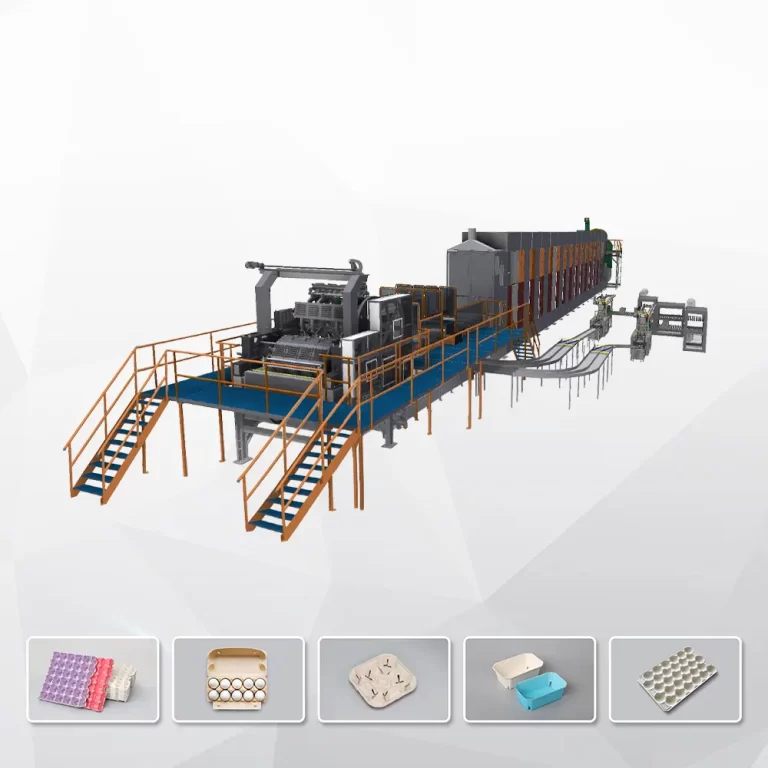
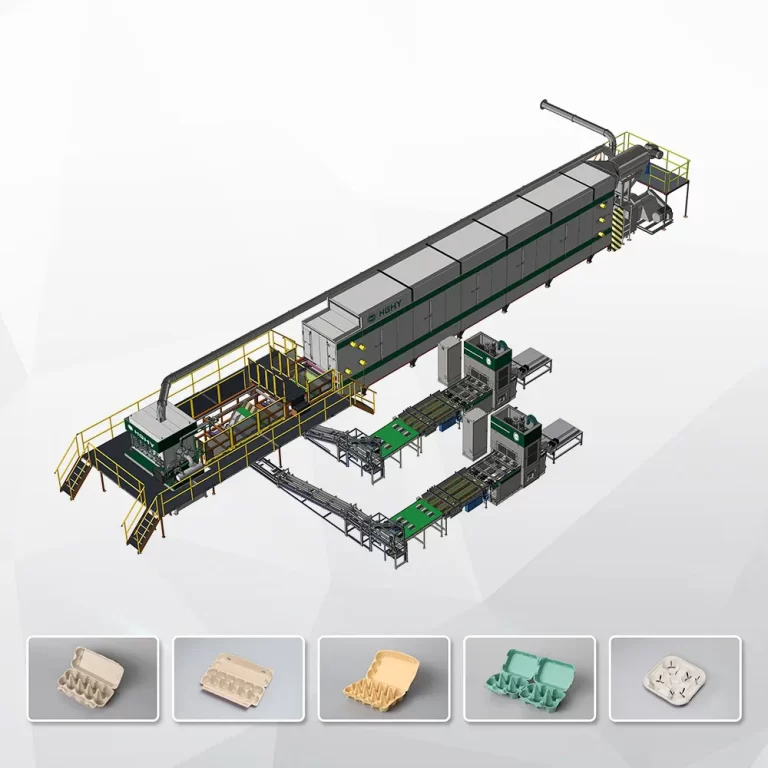
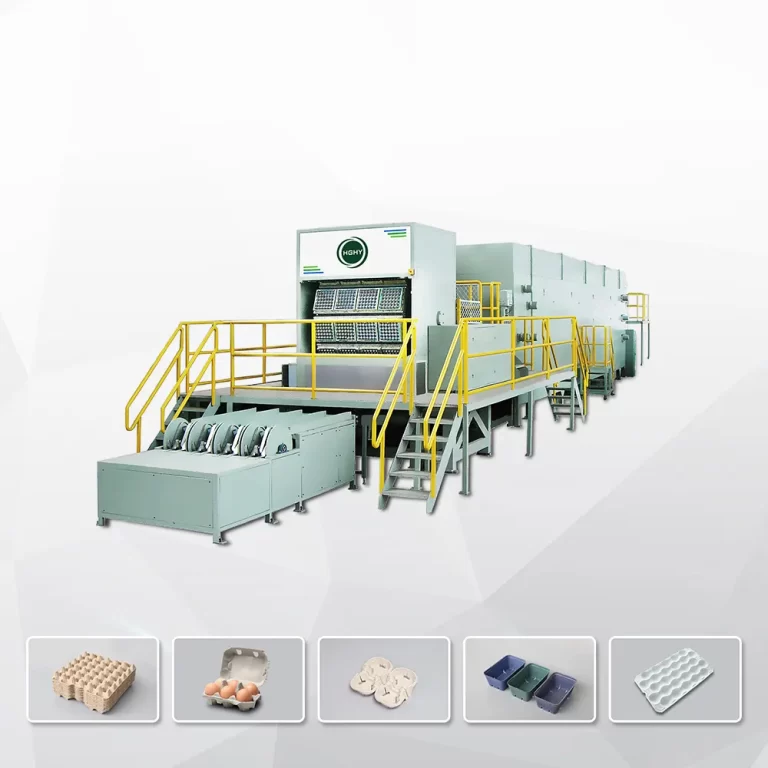

As the world continues to move toward sustainable and eco-friendly solutions, pulp egg tray and egg box production lines have become one of the most efficient and environmentally responsible alternatives to plastic packaging.
This guide provides a complete overview of the pulp molding technology, the production process, machine components, and key factors to consider when setting up a modern egg tray manufacturing business.

1. What Is a Pulp Egg Tray Production Line?
A pulp egg tray production line is a fully automated system that converts waste paper, cardboard, or other plant fibers into molded pulp packaging — mainly egg trays, egg cartons, and egg boxes.
It integrates multiple processes, including pulping, forming, drying, hot pressing, and packing, to produce biodegradable, compostable, and recyclable products.
Egg trays made from molded pulp are lightweight, shockproof, and moisture-resistant — ideal for protecting eggs during transport and storage.
More importantly, they are eco-friendly and comply with global regulations restricting single-use plastics.
2. Main Components of the Production Line
A standard pulp egg tray production line consists of several interconnected systems:
(1) Pulping System
- Raw materials such as waste paper, cartons, or old newspapers are mixed with water in a hydraulic pulper.
- The pulp passes through screening and refining equipment to remove impurities and achieve a uniform fiber consistency.
- This process prepares a slurry that will later be used for forming.
(2) Forming System
- The pulp slurry is transferred to the forming machine, where vacuum suction draws the fibers onto custom-designed molds.
- The molds define the shape of the egg trays or boxes (e.g., 30-cell trays, 6-cell or 12-cell boxes).
- The semi-wet molded product is then released and sent for drying.
(3) Drying System
- The formed trays are dried to remove moisture and solidify their structure.
- Common drying methods include:
- Metal drying line (automatic, fast, energy-efficient)
- Brick drying line (semi-automatic, cost-effective)
- Natural drying (manual, suitable for small-scale operations)
(4) Hot Pressing & Shaping
- For egg boxes or higher-end packaging, hot pressing improves surface finish, strength, and precision.
- It ensures the final product looks smooth, rigid, and professional.
(5) Stacking & Packaging System
- The final products are automatically stacked, counted, and packed for shipment.
- Automation ensures higher productivity and consistent quality.
3. Types of Egg Tray Production Machines
Different models are available depending on production capacity and automation level:
| Type | Features | Suitable For |
|---|---|---|
| Rotary Egg Tray Machine | Continuous forming, high efficiency, large output | Large-scale factories producing 10,000–20,000 pcs/hr |
| Reciprocating Egg Tray Machine | Simple design, moderate speed, flexible mold change | Medium-sized production lines |
| Manual / Semi-Automatic Line | Lower cost, requires more labor | Small businesses or startups |
| Fully Automatic Line | Integrated forming, drying, and packing | High-volume industrial production |
4. How the Production Process Works (Step-by-Step)
- Raw Material Input → Waste paper, cardboard
- Hydraulic Pulping → Mix and refine to pulp
- Pulp Supply → Pump to forming tank
- Vacuum Forming → Shape with molds
- Wet Tray Output → Transfer to drying line
- Drying Process → Remove moisture
- Hot Pressing (optional) → Improve quality
- Automatic Stacking & Counting → Prepare for packaging
- Final Product Output → Ready for storage or sale
5. Key Advantages of Pulp Egg Tray Production
Eco-Friendly & Sustainable – 100% biodegradable, made from recycled materials.
Cost-Effective – Low raw material and energy costs.
Strong & Durable – Excellent protection for eggs and other fragile items.
Customizable Designs – Mold flexibility for different tray and carton types.
High ROI – Growing market demand ensures quick payback for investments.
6. Applications Beyond Egg Packaging
The same pulp molding technology can produce a wide range of eco-friendly packaging, including:
- Fruit trays and cup holders
- Industrial packaging for electronics
- Tableware such as plates and bowls
- Cosmetic and gift box inserts
Expanding into these categories allows manufacturers to diversify and maximize equipment utilization.
7. Environmental & Economic Benefits
- Reduces landfill waste by recycling paper and cardboard
- Lowers carbon emissions compared to plastic or foam production
- Supports circular economy initiatives and meets environmental regulations
- Attracts eco-conscious customers and global retail partners
Many countries — especially in Europe, North America, and Southeast Asia — are actively banning or taxing plastic packaging, making pulp molded trays the natural replacement.
8. How to Choose the Right Production Line
When selecting a pulp egg tray production line, consider:
- Production capacity (e.g., 1000–10,000 pcs/hr)
- Automation level (manual, semi-auto, or fully automatic)
- Available space and energy supply
- Drying method (metal vs. brick)
- Local climate and labor cost
- After-sales service and spare parts availability
Partnering with an experienced manufacturer ensures reliable performance, high yield, and long-term technical support.
9. Future Trends in Pulp Molding Technology
- Integration of AI and smart control systems for precise forming and drying
- Development of multi-product molding lines for trays, cups, and boxes
- Use of renewable plant fibers (bagasse, bamboo, reed) for better strength and sustainability
- Continuous optimization for energy efficiency and water recycling
The global market for molded pulp packaging is expected to grow rapidly as both environmental regulations and consumer awareness increase.
10. Conclusion
A pulp egg tray and egg box production line represents the perfect combination of green innovation and industrial efficiency.
By turning waste paper into valuable, biodegradable packaging, manufacturers not only reduce pollution but also gain a profitable business opportunity in the global eco-packaging market.
Whether you’re starting a new factory or upgrading existing equipment, investing in modern pulp molding technology is the key to achieving sustainability, efficiency, and long-term success.
 English
  Spanish
  French
  Thai
Thai