

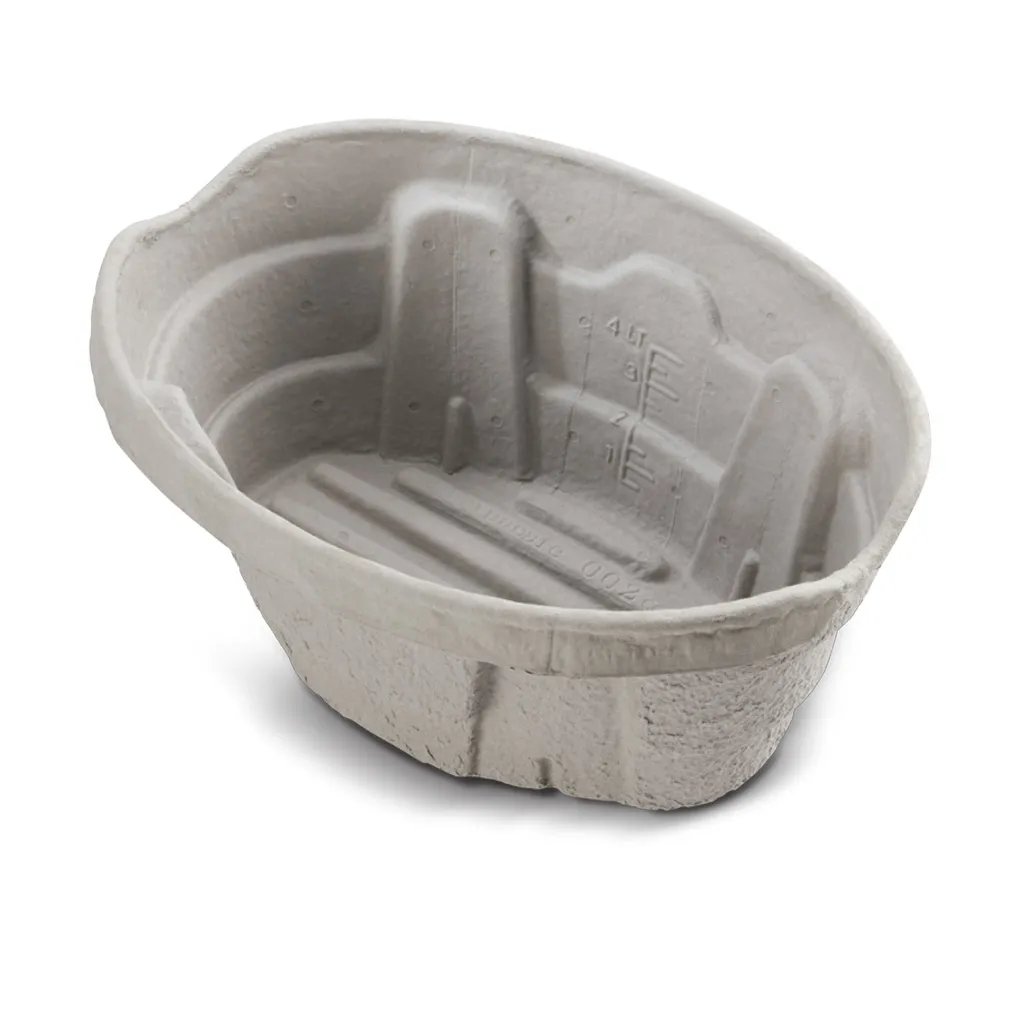
Hospitals go through single-use pulp products in enormous quantities. Bedpans, urinals, kidney dishes, wash bowls and cup holders are used once, then macerated or incinerated to break the chain of infection. For decades many of these items were made of plastic; today, molded fiber made from waste paper has become the material of choice — cheaper, incinerable without toxic residue, and aligned with the sustainability targets that now shape hospital procurement.
Producing these items at hospital-grade quality, and in the volumes a regional supply contract demands, is a different challenge from making egg trays. It is where fully automated molded fiber equipment earns its place. The question worth answering — for anyone weighing an investment, specifying a supplier, or building a greener hospital supply chain — is how large-scale output and strict medical standards can be met at the same time, starting from a raw material as humble as recovered paper.
Why waste paper suits medical disposables
The starting point of the whole process is recovered paper: old newspapers, cartons, printing offcuts and mixed office waste. Once pulped, cleaned and screened, these fibers form the wet stock that is molded into shape. Two things make this raw material well suited to hospital consumables.
First, cost and availability. Waste paper is abundant and inexpensive almost everywhere, which keeps the unit cost of a disposable bedpan low enough to compete with plastic — the decisive factor when a product is thrown away after a single use.
Second, disposal. Products molded from paper fiber can be macerated in a standard hospital pulp disposal unit or incinerated cleanly, without the persistent residues associated with plastic. That matches the infection-control logic of single-use care: the item is destroyed immediately after use, and the material it is made from does not linger.
The trade-off is that waste paper is variable. Fiber length, contamination and ink content differ from batch to batch, so the pulping and screening stages have to be robust enough to deliver a consistent stock. This is the first place where equipment quality separates a hospital-grade line from a basic one.
What “high standard” actually means for hospital products
A hospital disposable is not judged by the same yardstick as protective packaging. Several requirements apply at once:
- Structural integrity. A bedpan or urinal must hold liquid without leaking or softening during use, which demands controlled wall thickness and thorough drying.
- Surface consistency. A smooth, uniform surface is both a hygiene and an acceptance issue — rough or flaking edges are rejected by care staff.
- Dimensional accuracy. Products often sit in stainless steel support frames or maceration equipment, so they must match standard dimensions closely, batch after batch.
- Cleanliness of the fiber. Screening and cleaning have to remove plastics, staples and grit that would compromise the finished product.
Meeting these criteria once, in a sample, is straightforward. Meeting them across tens of thousands of pieces a day, without hand-sorting, is the real test — and that is a function of how well the line is automated.
How automation makes large-scale production possible
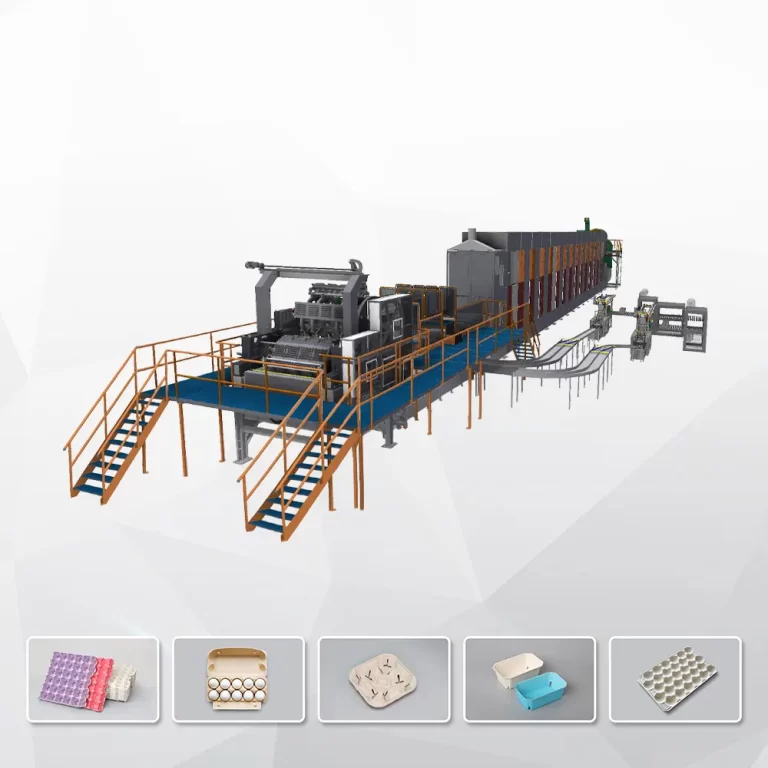
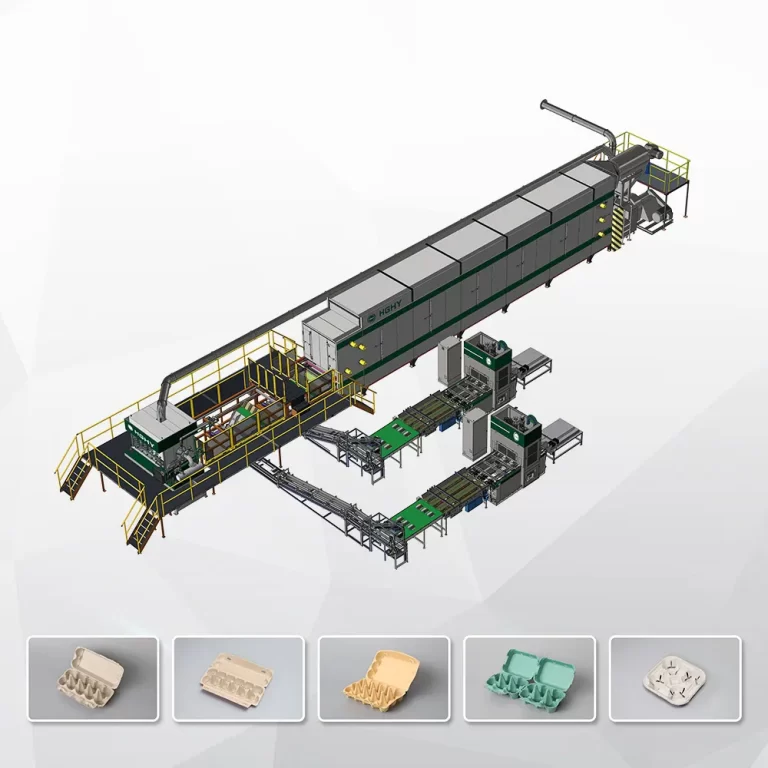
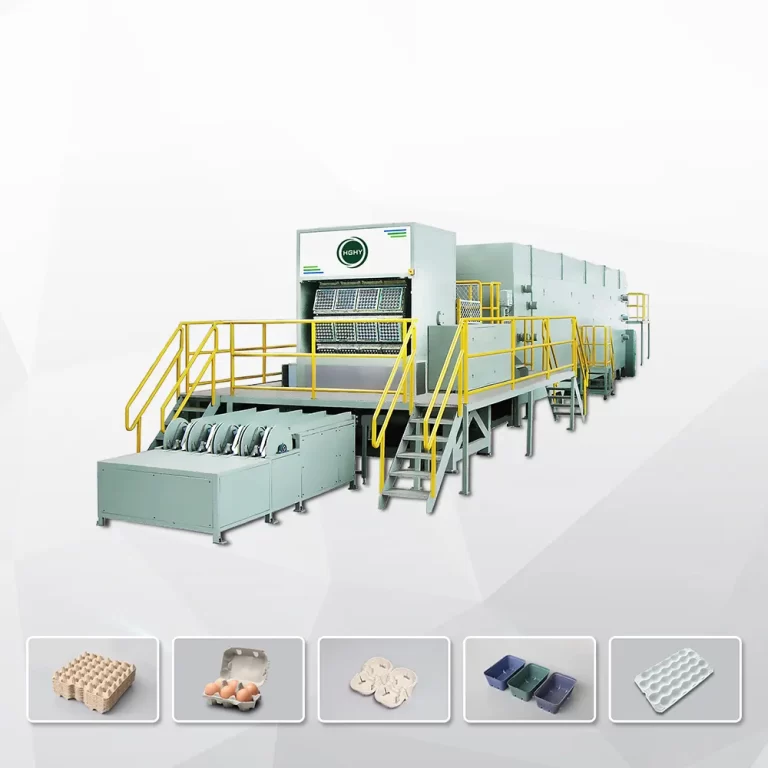
A fully automated molded fiber line links every stage into one continuous flow: pulp preparation, forming, hot-press drying, trimming, and stacking or packing. Removing manual transfer between these stages is what allows both high volume and stable quality.
Forming and drying in one continuous flow
The wet stock is drawn onto perforated molds under vacuum, which pulls water through the mesh and lays the fibers into shape. The formed pieces then pass directly into hot-press or tunnel drying, where heated dies give the product its final strength, smooth surface and stable dimensions. Because forming and drying are coupled on a single platform, the moisture content and wall thickness stay within a narrow band — the consistency that hospital products require.
In-line trimming and finishing
Automated trimming removes flash and squares off edges without an operator handling each piece. This is what keeps the surface and edge quality uniform at scale, and it is far more repeatable than manual finishing.
PLC control and quality monitoring
Modern lines run under programmable logic control, regulating pulp concentration, vacuum pressure, drying temperature and cycle time continuously. Stable process parameters are what turn a variable raw material — waste paper — into a uniform finished product. The tighter the control, the less the batch-to-batch variation that would otherwise show up in a stack of thousands.
Representative capacity of a hospital line
The figures below reflect typical published specifications for automated medical molded fiber lines in this class. Exact values depend on the configuration and product mix, and should be confirmed against a specific quotation.
| Parameter | Representative range |
|---|---|
| Raw material | Recovered waste paper / mixed pulp |
| Output | ~1,000–1,400 pieces/hour |
| Typical products | Bedpans, urinals, kidney dishes, wash bowls |
| Control system | PLC, automatic forming–drying–trimming |
| Operators required | 3 or fewer per line |
| Installation time | ~15–30 days depending on line size |
What each audience should take from this
The same equipment answers a different question depending on where the reader sits.
For eco-packaging and sustainability teams, molded fiber from waste paper closes a recycling loop: a low-value recovered material becomes a functional medical product that can be disposed of cleanly. It replaces single-use plastic in one of the highest-volume, hardest-to-substitute hospital categories.
For medical device and hospital procurement, the priority is consistency and compliance. Automated forming and drying deliver the dimensional accuracy and surface quality that care settings demand, while a stable line keeps a large supply contract reliably stocked rather than dependent on hand-finishing.
For green hospital construction, on-site or regional pulp disposables support maceration-based waste systems and reduce reliance on plastic consumables — a measurable contribution to a facility’s environmental profile.
For manufacturing investors, the appeal is a low-cost, widely available feedstock feeding a product with steady, non-cyclical hospital demand. High automation keeps labor low and output predictable, which is what underpins the economics of a single-use product.
Choosing the equipment behind the product
A finished bedpan is only ever as good as the line that formed it. When assessing a supplier, several points deserve direct questions: how the pulping and screening stages handle variable waste paper; whether forming and drying are integrated for consistent wall thickness; the degree of automation in trimming and stacking; and the level of process monitoring built into the control system.
As a molded fiber equipment manufacturer, HGHY builds automated pulp molding lines that run on recovered paper and mixed pulp, covering forming, hot-press drying and in-line finishing on a single platform. According to the company’s stated track record, its equipment has been installed for more than 300 clients across over 60 countries — experience that speaks to the repeatability of the lines across different markets and raw material conditions.
Large-scale production under high standards, in the end, is not a contradiction. It is the result of pairing an inexpensive, sustainable raw material with a line automated tightly enough to hold medical-grade quality across every piece it makes.
 English
 Spanish
 French
 Thai